

GUIDE: Concealed Cabinet Hinges
Cabinet hinges are a vital part of every kitchen, but eventually all hardware needs replacing. Perhaps the soft close function has failed, or the hinges under the sink have rusted. Maybe you're having a go at building your own kitchen from scratch. It's a simple enough job to fit a new hinge, but there are so many different types that you may not know where to start!
This guide will cover the basics of concealed cabinet hinges and mounting plates to help you find what type you'll need, but if you still need a hand please feel free to get in touch or have a look at our more general guide to hinges!
Contents
- Full overlay, half overlay or inset?
- Opening angle
- Mounting plates
- Click on, click off
- I only need the hinge/plate
- Some extra tips
Full overlay, half overlay or inset?
There are multiple ways that cabinet doors sit in/on their frame. The picture below shows you the difference between the three typical mounting types. Watch out for the difference between full overlay and half overlay! If you have two doors sitting next to each other, double check to see if they're both using the same frame (half overlay), or if they're sat on two separate frames next to each other (full overlay).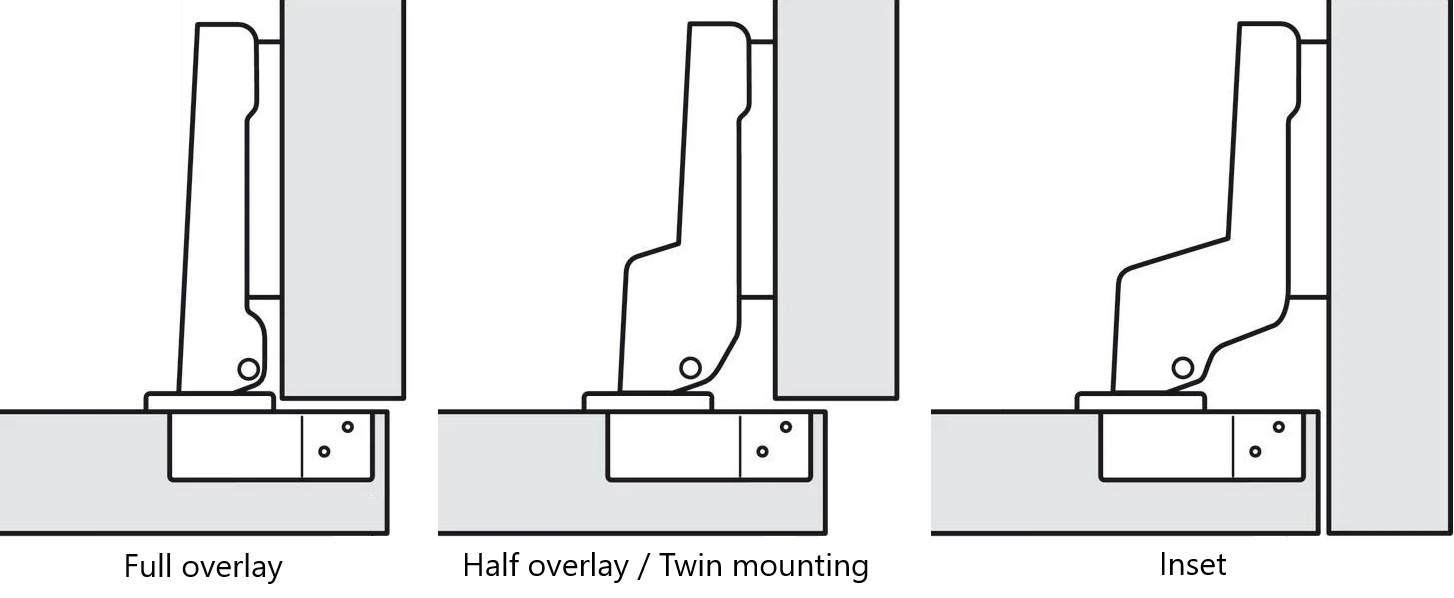
The differences are sometimes referred to by their "crank". See the difference in the height of the arms? A full overlay hinge is called a 0 mm crank, and an inset is usually a 15 mm crank. Half overlay sits somewhere inbetween, often at an 8 mm crank.
Opening angle
The opening angle is just as it sounds; it's how far the door will open. Most standard cabinets will have an opening angle of somewhere between 95-110°, but you can go anywhere up to 275°!
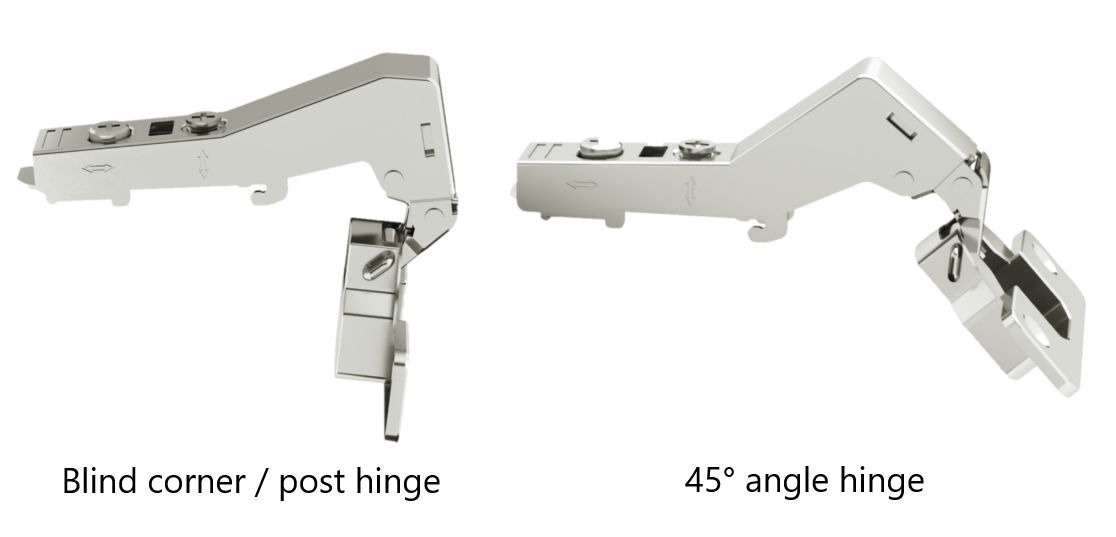
There are also some hinges that are designed specifically for corner units where you don't have an adjacent wall to attach the hinge to, called blind corner, post or pie-cut hinges, and others that are designed for angled cabinets, where you want the door to start at a non-standard angle (usually 30° or 45°, between two straight cabinets).
Mounting plates
Choosing your mounting plate is generally quite simple, despite the variety. As a rule of thumb, once you know what type of fitting your hinge is (see below), we would normally suggest a 0 mm height plate for full overlay and half overlay hinges, and a 2 mm height plate for inset. One-part plates are typically cheaper, but give you less adjustment after installation than two-part plates.
There are times that you will want plates with more or less height added to them (yes, there are minus height plates!), but for the average DIYer you shouldn't need these. Please feel free to get in touch if you need more advice.
The final thing you need to know for your mounting plate is what type of screws you want to use. If you've bought a pre-made carcass/frame, you will probably notice you already have some holes where your mounting plates will sit. If you have these (which tend to be a clean 5 mm Ø hole), you'll need a plate suitable for euro screws. These are blunt-ended screws, and usually come with the plate. If you don't have euro screw holes, you will need a plate suitable for wood/chipboard screws. These are the ones you'd probably think of instinctively, and have a pointed end to help them screw through the carcass.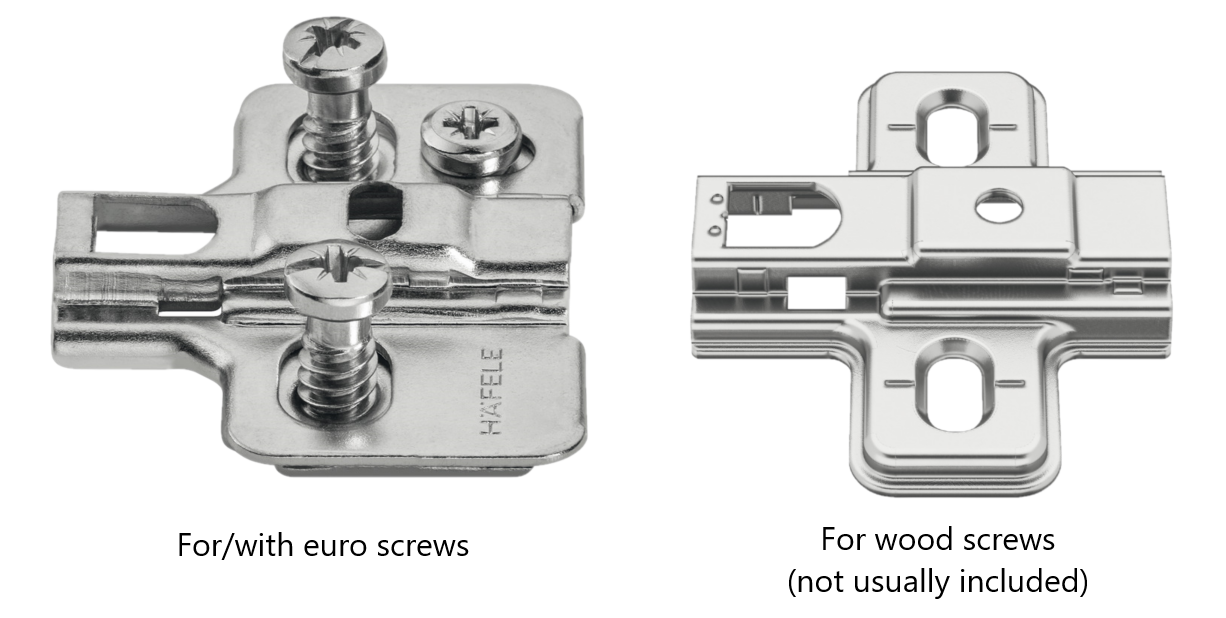
Click on, click off
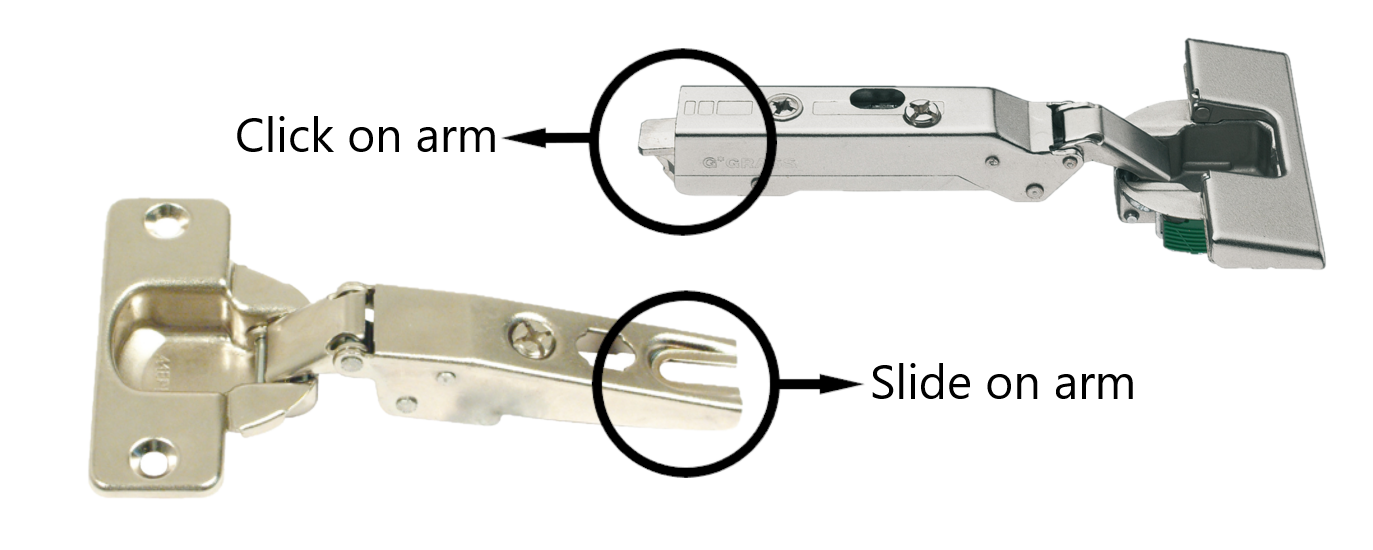
There are four or so different ways to fit hinges and plates together. Two are far more common than the others, which are the click-on and slide-on hinges & plates. The ends of the arm on the hinge are very different between the two, as illustrated below. If you're buying both hinge and plate and can't decide between the two, click-on seems to be the most popular choice amongst our Trade customers.
The other two types of fitting that we sell are impresso dowel fixing and quick-fixing. These are currently far more unusual, so if you're replacing an existing hinge or mounting plate we recommend replacing both parts, if you're unsure of what you have.
I only need the hinge/plate
Unfortunately, hinges and mounting plates aren't universally compatible. You often need the same brand and range for a hinge and plate to work together. If you're hoping to replace just one or the other, check inside the cup on the hinge (the bit that sits inside the door). Usually there's a brand name stamped in there, which will give you a good starting point!
The brands we sell are Nexis (Grass), Tiomos (also Grass), Hafele & DTC. We can also supply other brands, such as Blum, but we don't tend to keep these on the shelf so they can take a day or two longer to ship.
Some extra tips
This article should cover most of what you need, but here are some extra tips that may be helpful:
- Soft close - for most standard kitchen cupboards you only actually need one soft close hinge (or soft close add-on), unless your door is unusually heavy. As soft close hinges are more expensive than their standard counterparts, this should hopefully save you a little money! For taller cabinets, such as larder units, you will need at least two, possibly three. A good rule to use is half the number of overall hinges on the door, rounded up (so if you have 3 hinges you'll want 1.5 hinges to be soft close, which rounds up to 2).
- Push-to-open - if you're looking to install a push-to-open mechanism on your door, make sure you use unsprung hinges. Sprung hinges will counteract the push-to-open function, often making it unusable.
- As an additional note, you won't be able to turn an inset cupboard (where the door sits inside the frame) into a push-to-open one, unless you have something in place for the door to push against. This can be achieved, however, by something as simple as a block of wood where the push-to-open mechanism will sit. We don't recommend using the mechanism itself as the main support for the door, unless it's been specifically designed for this purpose.
- As an additional note, you won't be able to turn an inset cupboard (where the door sits inside the frame) into a push-to-open one, unless you have something in place for the door to push against. This can be achieved, however, by something as simple as a block of wood where the push-to-open mechanism will sit. We don't recommend using the mechanism itself as the main support for the door, unless it's been specifically designed for this purpose.
- Thicker doors - the standard door thickness for kitchen cabinets is 18mm, but it's not uncommon to have different sizes. If your cabinet door is over 22mm thick, you may struggle to find a suitable hinge. Click here for some 95° hinges designed for thicker doors, or contact us if you wanted to look for something different.
And that's it! If you're still having trouble, please feel free to ask us for help. If you're having trouble identifying an existing hinge, it would be worth sending us some photos so we can try and help. The more angles, the better!